Buying Guide
Access Security with Wall-Mounted Retractable Belt Systems
Discover how wall-mounted retractable belt systems are revolutionising access security...

Recevez en temps réel le statut de votre livraison
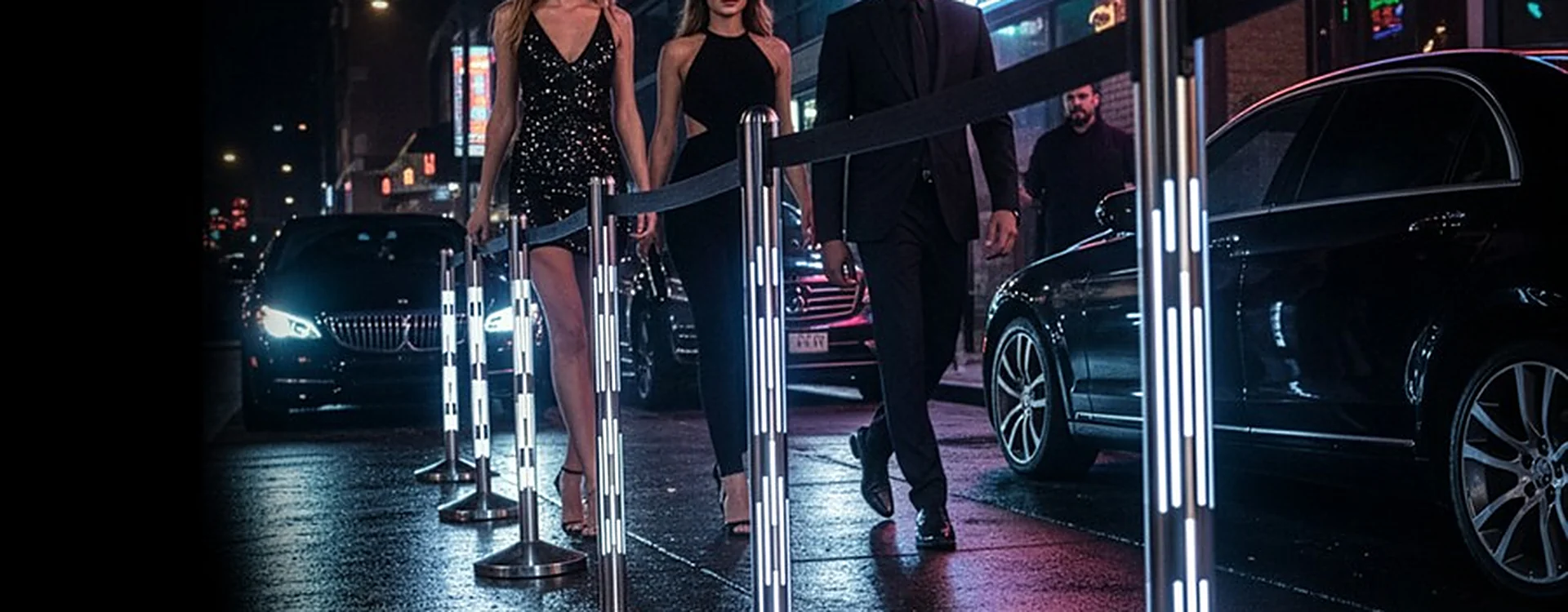
As soon as ambient light fades, conventional crowd control loses most of its effect: the belt disappears, the lane becomes guesswork and staff end up directing people by hand. The illuminated stanchion is built for exactly that moment.
Late-opening terraces, evening events, Christmas markets, night shifts in warehouses, roadworks after dark — a growing share of public-facing activity now happens in low light. Yet most guidance equipment was designed for daylight. A stainless steel post with a black belt, perfectly readable at 2 pm, is close to invisible at 10 pm.
An illuminated stanchion closes that gap. It does not simply mark a boundary, it lights it. The operational result is immediate: less hesitation at the entrance, fewer accidental crossings and far less staff time spent pointing the way.
An illuminated stanchion is a guidance post — usually with a retractable belt — whose shaft carries its own light source. Unlike a floodlight placed nearby, the light is part of the post: it signals the boundary instead of lighting the area. That distinction matters, because a floodlight creates shadows and glare, whereas a lit shaft draws a continuous line the eye follows naturally.
| Technology | Principle | Strengths | Limits |
|---|---|---|---|
| Integrated LED shaft | Light slots or strips running the full height of the post | 360° visibility, scenographic effect, adjustable colours | Higher initial cost, requires recharging |
| Beacon head | A single light module at the top of the post | Low cost, visible from a distance | Does not light the lower boundary, very industrial look |
| Retro-reflective belt | Reflective webbing that returns light from an external source | No power supply, no maintenance, minimal cost | Useless without a directed light source such as headlights |
💡 Key point: a retro-reflective belt only works if something is lighting it. In a pedestrian area with no vehicle traffic it adds almost nothing — the most common mistake on a first purchase.
In daylight, a visitor spots a guidance lane 15 to 20 metres ahead and adjusts course without thinking. In low light that distance often falls below 5 metres, especially for a black belt over dark flooring. Visitors no longer correct their path early: they walk right up to it, stop, look around, then go around. Repeated by hundreds of people, that micro-blockage is enough to saturate an entrance.
There is a hidden cost too. When the layout stops speaking for itself, someone has to speak for it — typically one or two staff members doing nothing but pointing. Over a season, that payroll line easily exceeds the price of the equipment that would have made it unnecessary. And the safety risk does not cancel out: a belt tensioned at hip height and invisible in the dark is the leading cause of reported incidents on guidance systems used at night.
Every illuminated post looks alike in a photograph. The differences show up in service, and they come down to seven points.
| Criterion | What to check | Quality benchmark |
|---|---|---|
| Battery life | Real runtime by mode and brightness | At least one full night in continuous use; 100 h+ in economy mode |
| IP rating | Resistance to water spray and dust | IP54 minimum as soon as there is any outdoor exposure |
| Charging | Connector type and charging time | Magnetic or sealed connection, full charge overnight |
| Shaft material | Corrosion and impact resistance | Brushed stainless steel for outdoor and coastal environments |
| Stability | Total weight and base diameter | 8 kg and a 30 cm base as a minimum for public use |
| Belt | Length, width, locking system | Around 2 m, with a locking and controlled-release mechanism |
| Control | Number of modes, brightness levels, remote | Several brightness levels and a supplied remote control |
This is where disappointment is most frequent. A stated runtime almost always refers to the most economical mode: minimum brightness, steady light, no dynamic effect. At full power with an animated mode, the same battery can last ten times less. Always read the range: a model rated 6 to 168 hours tells you it will cover a long evening at full brightness, and over a week in discreet standby lighting.
The two digits cover solids and water respectively. IP54 means protection against dust in non-harmful quantities and against water splashing from any direction — the relevant threshold for a post that spends the night outdoors in light rain or dew. Below that, keep it under cover. Above it, you are paying for immersion resistance a guidance post will never need.
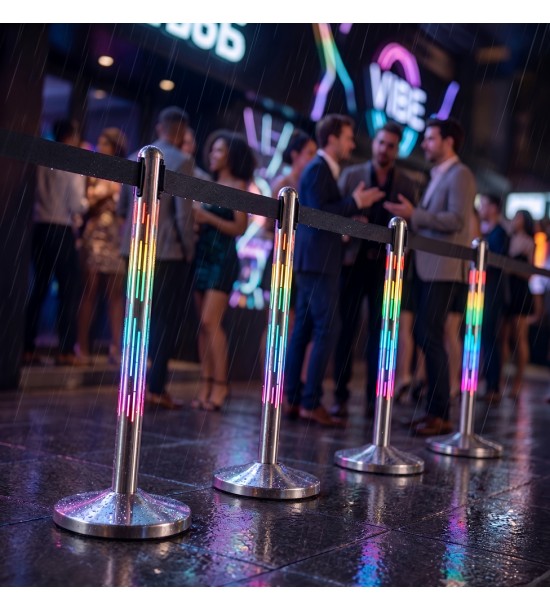
A modern illuminated post does more than glow white. RGB LED models let you choose hue and behaviour, and that freedom deserves a method rather than improvisation.
🎨 Simple rule: one colour, one message, and never change it mid-operation. Watch brightness too — in a dimly lit restaurant or auditorium, a post set to maximum becomes a glare point that draws attention for the wrong reasons.
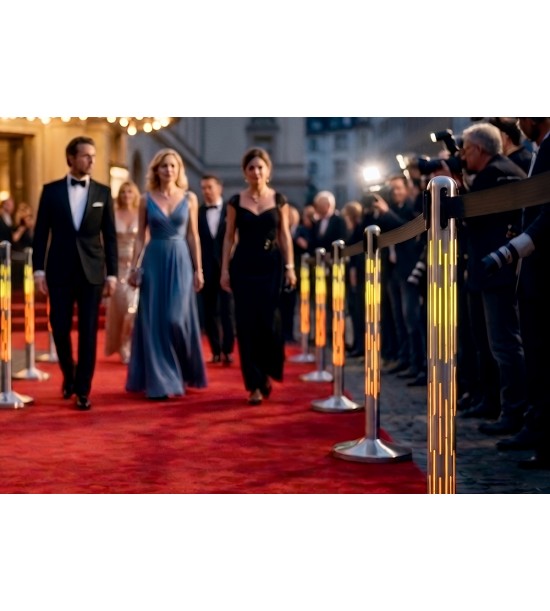
Yes, but its contribution differs. In daylight the lighting acts mainly as an attention signal and a staging element; readability is carried by the post structure and the belt. The investment is justified by at least partly nocturnal or low-light use.
No, on models with an integrated battery. That is their main advantage: placement is completely free, with no cables on the floor, so no trip hazard and no cable protection needed. Charging happens off-service, typically overnight.
Add up the real operating hours — often 10 to 12 per day, so 30 to 36 in total — and check the chosen lighting mode covers it. At medium brightness with steady light, a model rated up to 168 hours copes easily; in dynamic mode at full power, plan an intermediate recharge.
Yes, and it is the recommended way to control budget. The requirement is mechanical consistency: same height, same belt width, compatible receivers. Visually, keep the illuminated posts for decision points — entrance, junction, end of queue — and fill the rest of the line with standard posts.
An illuminated stanchion does not replace conventional crowd control: it takes over at the exact moment conventional equipment stops being read. If your activity includes low-light periods — evenings, late openings, unlit outdoor areas, dark rooms — this is the equipment that removes the most hesitation for the least operational effort.
Focus your analysis on real battery life in your operating mode, on an IP rating matched to your exposure, and on base stability. For professional outdoor use, the stainless steel LED stanchion post in our catalogue meets all three: IP54, an integrated battery rated 6 to 168 hours, a weighted base and remote control of brightness and colour. It integrates without adaptation into the rest of our retractable belt post range.
LED posts, belt posts, ropes and accessories: build a consistent system that stays readable by day and by night.
Explore our crowd control range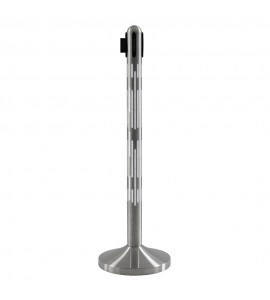
Related posts
Discover how wall-mounted retractable belt systems are revolutionising access security...
Everything about the wall receiver for stanchion posts: how it works, standard vs...
Elastic rope barrier posts deliver discreet, elegant crowd control for museums,...
From alarm red to safety green: decode every color code for crowd control and...