



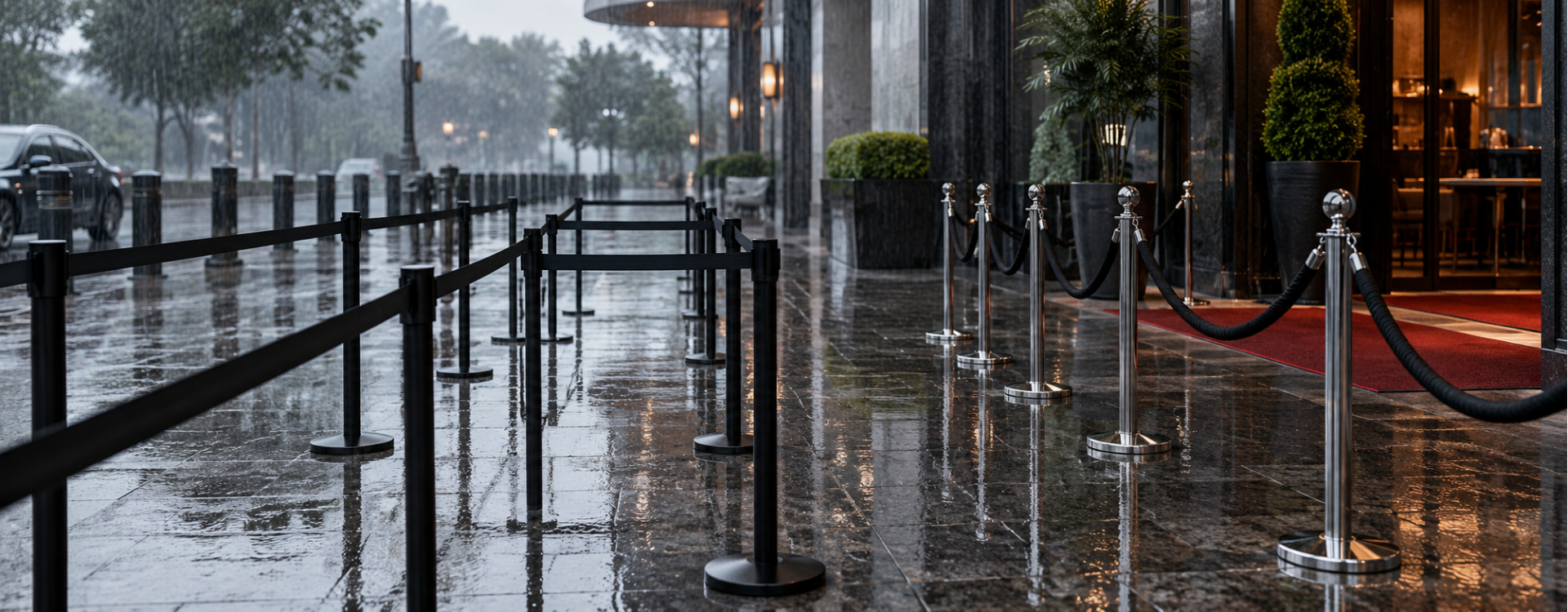
Outdoor Guidance Post: Common Mistakes to Avoid Before Buying
Using an outdoor guidance post requires very specific precautions. Too many organizers learn the hard way that textile belts, standard bases and retractable mechanisms aren't designed to withstand wind, rain or prolonged sun exposure. Here are the concrete mistakes to avoid before buying — and the right habits for occasional or semi-permanent outdoor use.
What is an outdoor guidance post used for?
In an event parking lot, outside a trade show entrance, at a polling station entrance, or to mark a sports course, outdoor posts serve the same role as indoor ones: structuring people flow. But the environment changes everything. Rain, wind, dust, UV rays: all factors that reduce equipment lifespan and can compromise safety.
The golden rule: textile belt posts aren't designed for permanent outdoor use. They can be used occasionally (an event, an open house day) then stored away. For permanent outdoor crowd control, you need other solutions: plastic-coated rope posts, Vauban barriers, fixed posts anchored to the ground.
Where to use them?
- Professional events: trade shows, conferences, outdoor fairs, open-air exhibitions
- Festivals and concerts: waiting areas, pole access, temporary bars
- Markets and flea markets: temporary stall marking
- Polling stations: organizing queues outside public buildings
- Event parking: vehicle-pedestrian guidance
- Temporary construction sites: quick marking of work areas
Selection criteria for outdoor use
Textile belt vs plastic-coated belt
Standard textile belts absorb moisture and lose 30% of their resistance after a season of UV exposure. For regular outdoor use, choose plastic-coated belts or rope posts. Rope resists moisture and UV better, and remains usable for several years outdoors.
Wind stability
A 7 kg base, sufficient indoors, becomes critical beyond 30 km/h wind. For reliable outdoor use, aim for 15 to 20 kg base minimum, or use additional ballast systems (sandbags). Beyond 50 km/h, fold away any belt installation.
Occasional vs semi-permanent use
Occasional use (1-2 days) is tolerable with indoor equipment, provided you store it in the evening. Semi-permanent use (several weeks) requires specific outdoor equipment: reinforced base, UV-treated belt or marine rope, stainless steel mechanisms.
Storage and drying
If the belt is exposed to rain, let it dry completely before retracting it. A wet rewound belt warps, can block the internal spring and ruins the mechanism. This is mistake #1 at rainy events.
Common mistakes
- Buying indoor equipment for permanent outdoor use: the belt frays in a few weeks, the mechanism jams, the base rusts. Total cost disaster.
- Rewinding a wet belt: action #1 that destroys a mechanism. Always let dry completely before retraction.
- Ignoring weather forecasts: check gusts before an outdoor event. Beyond 50 km/h, plan a backup solution (storage, additional anchoring).
- Using bases that are too light: under 12 kg outdoors, the post tips over. Ballast with sandbags if necessary.
- Storing in direct sunlight between events: UV rays dull finishes and weaken belts. Store in shade, in a cover.
Solutions adapted for outdoor use
For reliable outdoor crowd control, several alternatives to standard belt posts:
- Plastic-coated rope posts: better weather resistance, neat appearance. See our cord post catalog.
- Plastic chain posts: very resistant, economical, industrial appearance. Suitable for construction sites and temporary areas.
- Vauban barriers: for large events, security perimeters, festivals.
- Safety cones: very occasional marking, parking, diversions.
For complete organization of your outdoor events, read event crowd control: organizing flow at a trade show. For belt maintenance, check when to replace your post belt. For an overview of posts, return to the complete guide to professional guidance posts.
FAQ
Can you use a belt guidance post outside?
Yes, but occasionally and in dry conditions only. Textile belts don't resist permanent outdoor use. For a few-hour event in good weather, it's tolerable provided you store everything afterwards. For regular use, choose plastic-coated rope posts or Vauban barriers.
What to do if the belt gets wet during the event?
Leave it unfolded and let it dry completely before retracting it into the mechanism. A wet rewound belt warps, loses its smoothness and can block the internal spring. If necessary, remove it and hang it for drying before reassembly.
What base weight to resist wind?
For reliable outdoor use, aim for 15 to 20 kg base minimum. Beyond 30 km/h wind, add ballast with sandbags. Beyond 50 km/h gusts, fold the installation and switch to anchored solutions (Vauban, fixed posts).
How long does a post used outdoors last?
It depends on the model and usage. A textile belt post in permanent outdoor use lasts 6 to 18 months maximum. A plastic-coated rope post lasts 3 to 5 years. A Vauban barrier lasts 8 to 15 years. Annual amortization cost is generally lower with equipment suited for outdoor use.
Should equipment be UV-treated?
For regular outdoor use, yes. Professional manufacturers offer brushed stainless steel finishes (weather-resistant), UV-treated plastic-coated belts or marine ropes. Check the technical sheet: "exterior" or "outdoor" should appear on it.
Related products
-

-

-

Outdoor Guidance Post (Yellow) - BELTRAC OUTDOOR
Old price: €124.80 Price: €106.08 Discount: 15% Save up: -€18.72Fillable barrier post for outdoor use, in yellow color. -
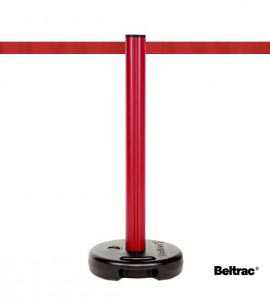
Outdoor Queue Post (Red) - BELTRAC OUTDOOR
Old price: €124.80 Price: €106.08 Discount: 15% Save up: -€18.72Red PVC post designed for outdoor use, with weighted base. -

BELTRAC OUTDOOR Weatherproof Queue Post (Black)
Old price: €125.00 Price: €106.25 Discount: 15% Save up: -€18.75Outdoor queue post designed for exterior use, PVC plastic tube, fillable base. -

Stainless Steel Rope Barrier Post (Brushed Finish)
Old price: €158.45 Price: €142.61 Discount: 10% Save up: -€15.85Guide post with brushed stainless steel finish, for Potelet® ropes. -

Premium Intervention Barrier Kit with Transport Cart
Old price: €3,724.00 Price: €3,351.60 Discount: 10% Save up: -€372.40Transport cart including 25 emergency intervention barrier posts! -

Polished Chrome Ball-Top Rope Post
Old price: €172.80 Price: €155.52 Discount: 10% Save up: -€17.28"Crown" rope post, ball top (Polished chrome finish). -

Luxor Chrome Rope Post 95cm with 4-Way Cup
Old price: €152.40 Price: €137.16 Discount: 10% Save up: -€15.24Luxor Beltrac chrome rope post for elegant queue management. -

Brass Ball-Top Rope Post Crown Series
Old price: €172.80 Price: €155.52 Discount: 10% Save up: -€17.28Beltrac Crown brass rope post with decorative ball top. -

Chrome Rope Guidance Post Professional
Old price: €114.00 Price: €102.60 Discount: 10% Save up: -€11.40Guidance post from the Beltrac Style range. High quality, lowest price! -

Brass Rope Guidance Post Premium
Old price: €127.20 Price: €114.48 Discount: 10% Save up: -€12.72Guidance post for hemp, velvet or polypropylene Beltrac ropes. -

Golden Rope Post - Luxor Premium
Old price: €172.80 Price: €155.52 Discount: 10% Save up: -€17.28Luxor Beltrac golden brass rope guidance post. -

Chrome Ball Top Rope Post for Permanent Installation
Price: €168.00Chrome rope guidance post with ball top, for permanent ground installation.
Related posts
-
 A4 Sign Holder for Queue Post: Vertical or Horizontal?
Portrait or landscape: which format for your welcome messages on guidance posts? Selection criteria based on content.Read More
A4 Sign Holder for Queue Post: Vertical or Horizontal?
Portrait or landscape: which format for your welcome messages on guidance posts? Selection criteria based on content.Read More