



Temporary Site Marking
A4 Sign Holder for Queue Post: Vertical or Horizontal?
Portrait or landscape: which format for your welcome messages on guidance posts?...

Recevez en temps réel le statut de votre livraison
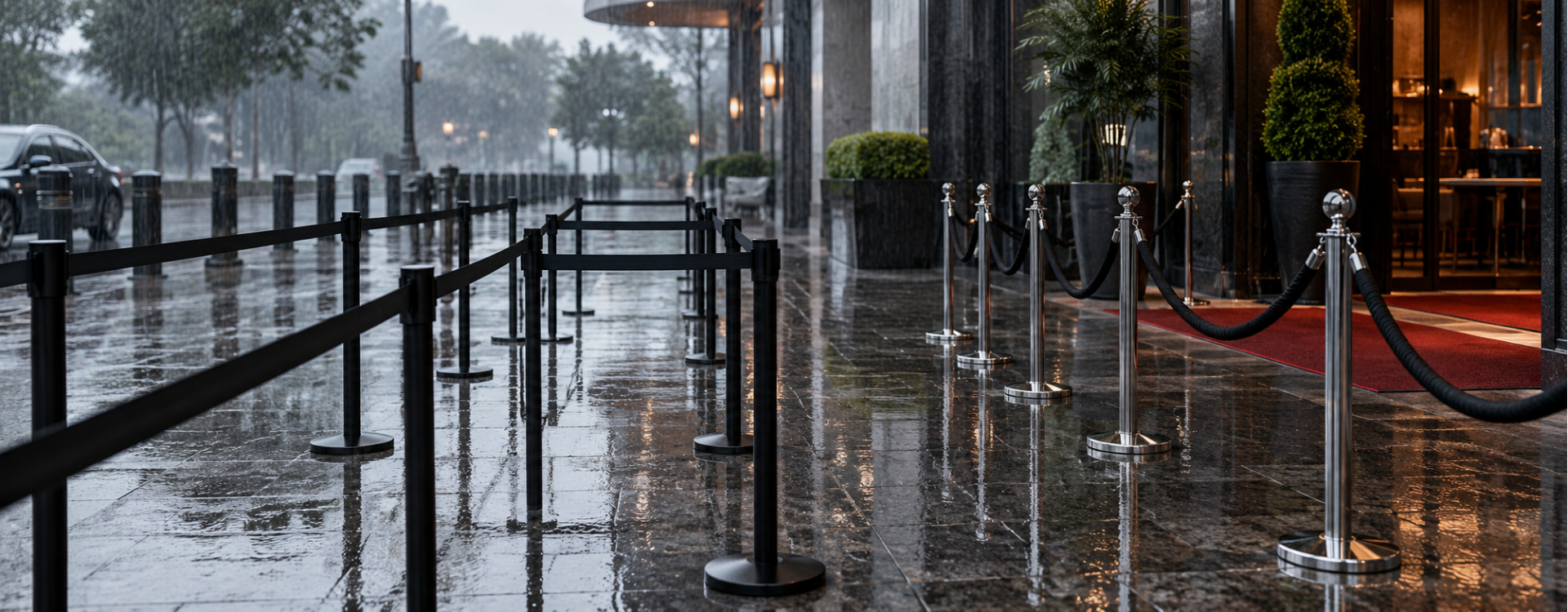
Using an outdoor guidance post requires very specific precautions. Too many organizers learn the hard way that textile belts, standard bases and retractable mechanisms aren't designed to withstand wind, rain or prolonged sun exposure. Here are the concrete mistakes to avoid before buying - and the right habits for occasional or semi-permanent outdoor use.
In an event parking lot, outside a trade show entrance, at a polling station entrance, or to mark a sports course, outdoor posts serve the same role as indoor ones: structuring people flow. But the environment changes everything. Rain, wind, dust, UV rays: all factors that reduce equipment lifespan and can compromise safety.
The golden rule: textile belt posts aren't designed for permanent outdoor use. They can be used occasionally (an event, an open house day) then stored away. For permanent outdoor crowd control, you need other solutions: plastic-coated rope posts, Vauban barriers, fixed posts anchored to the ground.
Standard textile belts absorb moisture and lose 30% of their resistance after a season of UV exposure. For regular outdoor use, choose plastic-coated belts or rope posts. Rope resists moisture and UV better, and remains usable for several years outdoors.
A 7 kg base, sufficient indoors, becomes critical beyond 30 km/h wind. For reliable outdoor use, aim for 15 to 20 kg base minimum, or use additional ballast systems (sandbags). Beyond 50 km/h, fold away any belt installation.
Occasional use (1-2 days) is tolerable with indoor equipment, provided you store it in the evening. Semi-permanent use (several weeks) requires specific outdoor equipment: reinforced base, UV-treated belt or marine rope, stainless steel mechanisms.
If the belt is exposed to rain, let it dry completely before retracting it. A wet rewound belt warps, can block the internal spring and ruins the mechanism. This is mistake #1 at rainy events.
For reliable outdoor crowd control, several alternatives to standard belt posts:
For complete organization of your outdoor events, read event crowd control: organizing flow at a trade show. For belt maintenance, check when to replace your post belt. For an overview of posts, return to the complete guide to professional guidance posts.
Yes, but occasionally and in dry conditions only. Textile belts don't resist permanent outdoor use. For a few-hour event in good weather, it's tolerable provided you store everything afterwards. For regular use, choose plastic-coated rope posts or Vauban barriers.
Leave it unfolded and let it dry completely before retracting it into the mechanism. A wet rewound belt warps, loses its smoothness and can block the internal spring. If necessary, remove it and hang it for drying before reassembly.
For reliable outdoor use, aim for 15 to 20 kg base minimum. Beyond 30 km/h wind, add ballast with sandbags. Beyond 50 km/h gusts, fold the installation and switch to anchored solutions (Vauban, fixed posts).
It depends on the model and usage. A textile belt post in permanent outdoor use lasts 6 to 18 months maximum. A plastic-coated rope post lasts 3 to 5 years. A Vauban barrier lasts 8 to 15 years. Annual amortization cost is generally lower with equipment suited for outdoor use.
For regular outdoor use, yes. Professional manufacturers offer brushed stainless steel finishes (weather-resistant), UV-treated plastic-coated belts or marine ropes. Check the technical sheet: "exterior" or "outdoor" should appear on it.





Related posts
Portrait or landscape: which format for your welcome messages on guidance posts?...