Before choosing a mobile strap post, several questions arise depending on your use: type of environment, intensity of traffic, installation constraints or even standards to respect. This FAQ addresses the essential points to help you effectively structure your spaces and optimize flow management.
When should you use a mobile strap post rather than a fixed barrier?
+
The mobile strap post is preferred when the organization of flows must remain flexible. Unlike a fixed barrier, it allows you to quickly modify a route, open or close an area, or adapt a queue depending on the number of people.
It is particularly suitable for environments where configurations change regularly: reception, retail, events, temporary waiting areas.
What length of strap should you choose depending on the configuration of the space?
+
The choice of strap length depends mainly on the distance to be covered between the posts and the configuration of your space. Shorter lengths are typically used in constrained environments or to structure queues with a tight mesh, while longer straps allow wider areas to be covered with fewer anchor points.
In practice, several lengths exist to adapt to different uses. The right choice consists of finding a balance between legibility of the route, stability of the system and optimization of the number of posts.
Are strap poles suitable for outdoor use?
+
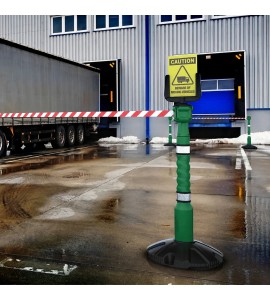
Some strap poles are designed for outdoor use, but not all models are. Adaptability depends in particular on the materials and finishes used, in particular their resistance to humidity and climatic conditions.
For outdoor use, it is therefore important to check the technical characteristics of the product or to opt for models specifically designed for this environment. In case of doubt or particular constraint, it is recommended to seek advice from our sales team in order to validate the appropriate configuration.
How to effectively organize a queue with strap posts?
+
The organization depends on the space available and the volume of traffic.
The most used configurations are:
- linear file (simple and quick to set up)
- serpentine queue (optimizes space and reduces the perception of waiting)
It is recommended to provide clear signage (entrance/exit) and to maintain regular distances between posts to ensure legibility of the route.
Can we personalize the straps (color, marking, message)?
+
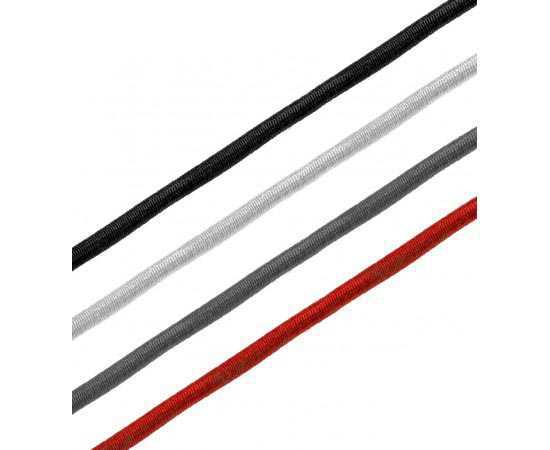
Yes, it is possible to personalize the straps. This makes it possible to integrate specific marking: orientation message, safety instructions, branding or zone identification.
Personalization is often used in retail, event or corporate environments.
Are there any standards or recommendations for the use of guide posts in ERP?
+
There is no single standard specific to strap posts, but their use is part of broader requirements linked to ERPs (Establishments Receiving the Public):
- accessibility of paths
- evacuation in case of emergency
- absence of dangerous obstacle
The device must therefore remain easily removable and not interfere with regulatory traffic.
Is it possible to connect several poles together flexibly?
+
Yes, strap posts are designed to be interconnected easily. Our models have fixing systems allowing several posts to be connected in different directions, which offers great flexibility to create routes adapted to each space configuration.
Which belt length to choose: 2 m or 3 m?
+
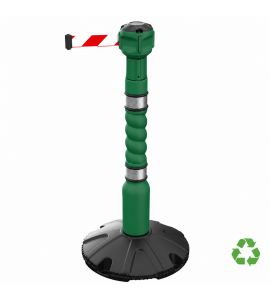
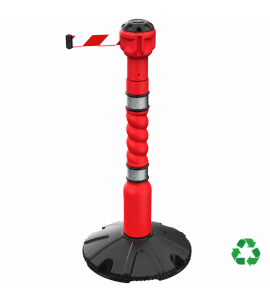
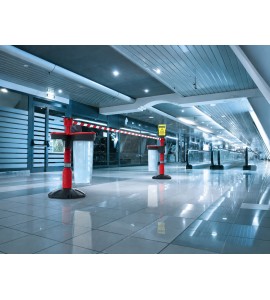
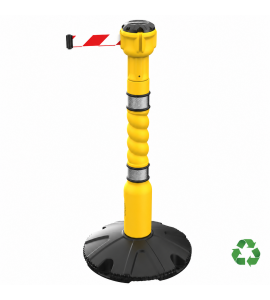
The choice depends on the width of the areas to be cordoned off. A 2 m belt is suitable for narrow corridors and compact queues. The 3 m belt, as featured on the Skipper Q posts from CrowdControlCentral, is recommended for large lobbies, airports or showrooms where spans exceed 2 m. It reduces the number of posts required and simplifies the overall setup.
Are mobile belt barrier posts suitable for outdoor use?
+
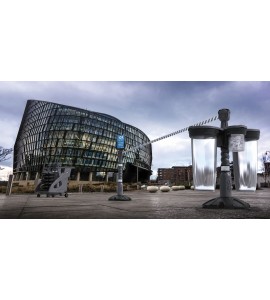
Yes, provided the model is designed for this purpose. Skipper Q posts are made from UV-resistant polypropylene and withstand normal outdoor conditions (rain, sun, temperature variations). For permanent outdoor installations, it is recommended to fill the base with sand rather than water to prevent frost damage during winter months.
How do you ballast the base of a mobile belt post?
+
The base of mobile belt barrier posts such as the Skipper Q is designed to be filled with water or dry sand. Water is convenient for temporary indoor use and easy to drain. Sand is preferable for outdoor or long-term installations, as it provides more stable ballast and cannot freeze. Filling the base two-thirds full is generally sufficient for most applications.
Can I order custom belts in my brand colours?
+
Yes. CrowdControlCentral offers custom printed belts for the Skipper Q range. Logos, brand colours or any message can be printed directly onto the belt. This option is particularly popular with hotels, retailers and event organisers who want to extend their visual identity to their crowd control equipment. Contact our team for a personalised quote.
What is the difference between a belt barrier post and a rope post?
+
A belt barrier post features an automatically retractable polyester belt - quick to deploy and retract. A rope post uses a rope (velvet, nylon or hemp) suspended between posts via hooks, offering a more classic and upscale appearance. Skipper Q belt posts are preferred for dynamic crowd flow management (queues, temporary access), while rope posts are better suited to permanent prestige environments.
Can Skipper Q belt posts be connected to each other?
+
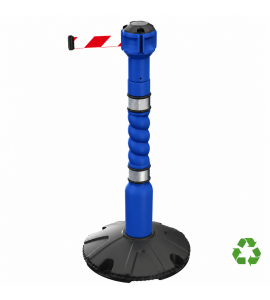
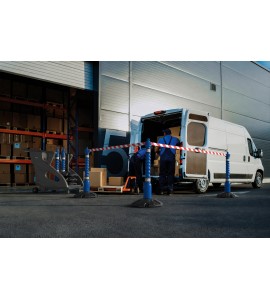
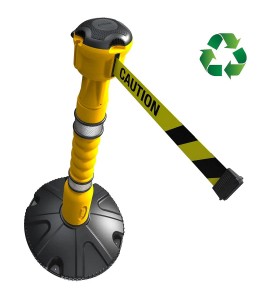
Yes. Skipper Q posts are designed to work as a system: the belt from each post can be locked into the receiver of the next post, enabling straight lines or angled configurations. Multiple posts can be chained together to cordon off large areas. This modularity is one of the key strengths of the range, which also allows belts to be replaced or swapped for different colours.
Is there cross-brand compatibility between post head systems?
+
Cross-brand compatibility depends on the connection type used. Belt systems are not universally standardised - each manufacturer may adopt a proprietary design. Skipper Q belts are compatible within the range itself but are not guaranteed to be compatible with posts from other manufacturers. If in doubt, it is best to test with a sample first or contact our team before placing an order.
What is the delivery time for belt barrier posts?
+
CrowdControlCentral strives to ensure fast delivery times across the full range of belt barrier posts, including the Skipper Q. For exact availability and current lead times at the time of your order, please check the product page on our website or contact our sales team directly - they can also provide tailored solutions for urgent orders.