Buying Guide
Access Security with Wall-Mounted Retractable Belt Systems
Discover how wall-mounted retractable belt systems are revolutionising access security...

Recevez en temps réel le statut de votre livraison

The wall-mounted retractable belt is the complementary solution to classic guidance posts: a retractable unit fixed directly to the wall or counter, which avoids using a dedicated post to start the queue. Practical, aesthetic, space-saving: it becomes essential whenever a wall or partition borders the area to be channeled. Here are the typical uses and selection criteria to make the right choice.
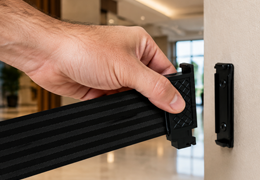
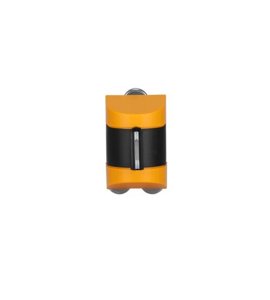
The principle is simple: a compact unit (generally 10 × 10 cm) is fixed to the wall, counter or furniture. Inside, a retractable mechanism contains a 2 to 5-meter belt, equipped with a clip. The belt extends on demand and automatically retracts when released. At the other end, you attach either a post or a wall receiver for 100% wall-mounted configurations.
The main benefit is space saving: no need for a 100 cm high post at the start of the queue. The visitor arrives directly in front of the counter, and the queue organizes visibly behind. It's also more aesthetic for well-designed reception areas.
Standard: 2.5 m, 3 m or 5 m. For a compact reception area, 2.5 m is sufficient. To cross a corridor or hall, choose 5 m. Beyond that, the belt sags and loses visual clarity.
Essential. Without a brake, the belt retracts brutally when released, with risk of injuring a visitor (face, eyes). A good mechanism limits return speed to 1 m/s maximum. Check this point in the technical specifications.
Three options: screwed to wall (permanent, robust), magnetic (mobile on metal supports), self-adhesive (temporary, avoid for intensive public use). Screwed mounting remains the standard for permanent installations.
For 100% wall-mounted configurations (wall to wall), a simple wall receiver at the opposite end is sufficient. This is a metal piece fixed to the wall that receives the belt clip. More economical than a second retractor.
Most wall-mounted retractor belts attach to classic belt posts. Check that the clip is compatible with your brand (BELTRAC, POTELET, JET TRAC). When in doubt, choose the same manufacturer for the retractor as for the posts.
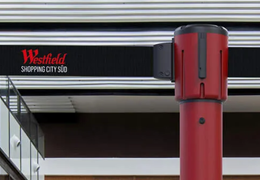
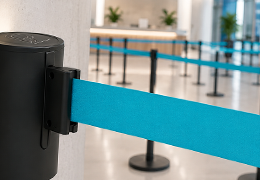
The wall-mounted retractor combines perfectly with an existing fleet of belt guidance posts. Classic configurations:
This modularity allows you to reduce the number of posts needed by 30 to 50% in spaces where walls serve as natural support.
To discover our complete catalog of wall-mounted retractors, see wall-mounted barriers. For the complete overview of the subject, return to the complete guide to professional guidance posts.
Standard lengths are 2.5 m, 3 m and 5 m. For a reception counter, 2.5 m to 3 m is sufficient. To cross a hall or corridor, choose 5 m. Measure the distance to cover and allow a 50 cm margin.
Most often yes, the standard belt clip adapts to posts from major brands. To avoid any disappointment, choose the retractor from the same manufacturer as your posts (BELTRAC, POTELET, JET TRAC).
For permanent use in public spaces, screwed mounting is more reliable. Magnetic is suitable for mobile installations (events, fairs) on metal supports. Self-adhesive mounting is only tolerable for temporary private use.
Not with a brake mechanism compliant with European standards: return speed is limited to 1 m/s maximum. Without a brake, the belt can injure the face or eyes. Always check for "belt brake" mention in the technical specifications.
For outdoor use, choose a treated model (stainless steel housing, plastic-coated belt). Standard indoor retractors quickly seize up due to humidity and dust.


Related posts
Discover how wall-mounted retractable belt systems are revolutionising access security...
Choisir un poteau de guidage professionnel ne se limite pas à comparer des prix sur...
Everything about the wall receiver for stanchion posts: how it works, standard vs...
Everything about the 5m belt stanchion post: comparison with standard, 6 use cases,...
Complete guide to outdoor stanchion posts: material comparison (304/316 SS, aluminium,...