Buying Guide
Access Security with Wall-Mounted Retractable Belt Systems
Discover how wall-mounted retractable belt systems are revolutionising access security...

Recevez en temps réel le statut de votre livraison

Queue management is as much a science as it is an art. Well organized, a queue reduces the perception of waiting time, defuses tensions and strengthens public confidence. Poorly organized, it frustrates visitors, blocks operations and can even generate incidents. Here are the proven principles and practical solutions for structuring a queue in a public space.
An unorganized queue is not just an aesthetic problem: it has a measurable impact on visitor experience. Recurring studies in queue theory:
For these reasons, queue organization is a high ROI investment: a well-sized fleet of belt stanchions pays for itself in just a few months.
The single serpentine queue is mathematically more efficient than multiple parallel queues. It better distributes visitors among available counters and reduces the frustration of "the next queue moves faster". Standard in banks, airports, government offices.
Multiple queues are only relevant if each counter has a truly different function (checkout, returns, info, advice). Otherwise, always use a single queue system.
The spacing between posts depends on the configuration:
Clearly indicating "WAIT HERE" or "NEXT AVAILABLE COUNTER" reduces visitor anxiety. See queue signage and sign holders for posts.
Basis of organization. Modular, deployable, customizable. For intensive public use, aim for bases of 9-12 kg minimum, 3 m belts, 4-way mechanism.
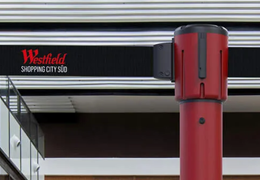
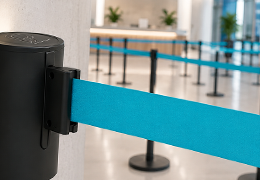
To start the queue from a wall or counter, without a dedicated post. Space saving, neat aesthetics. Read wall-mounted belt retractor.
Complement posts with floor marking (stickers or tapes) to mark waiting positions. Particularly useful for areas with imposed distancing. Favor non-slip and traffic-resistant adhesive materials.
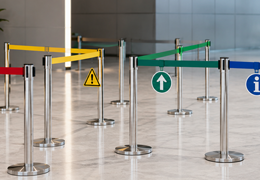
Suspended panels, sign holders on posts, floor arrows. Combine supports to avoid confusion. Use a consistent color code (for example blue = standard customer, red = priority queue).
Any queue in a public space must be accessible to people with reduced mobility: minimum width of 1.5 m between posts for wheelchairs, identified priority queue, non-slip floor. This is a legal obligation in all public buildings.
For a bank branch with 4 counters, the typical organization:
Total cost: €1,800 to €2,500 excluding tax for equipment that will last 8-10 years with proper maintenance.
For the overview, return to the complete professional guidance post guide. See our belt stanchion catalog.
The single serpentine queue is mathematically more efficient as soon as there are several equivalent counters. It better distributes visitors and reduces frustration. Multiple queues are only relevant if each counter has a truly different function.
1.5 m minimum between posts to allow wheelchair passage. The priority queue must be clearly identified by distinctive signage. This is a legal obligation in public buildings.
In serpentine configuration (1.8 m spacing), a queue of 10 people measures about 12 m long. Count 7 to 8 posts + 2 wall supports or retractors at the ends, about 10 elements in total.
Recommended for public areas. Floor marking materializes waiting positions and visually complements the posts. Particularly useful in case of imposed distancing or for queues with heavy traffic.
Plan a protocol to open additional queues: additional mobile posts, wall retractors to extend the area, dedicated agent for regulation. Anticipate peaks by observing historical data (day, hour, seasonality).















Related posts
Discover how wall-mounted retractable belt systems are revolutionising access security...
Everything about the 5m belt stanchion post: comparison with standard, 6 use cases,...
Elastic rope barrier posts deliver discreet, elegant crowd control for museums,...
From alarm red to safety green: decode every color code for crowd control and...
Everything about the low stanchion 45 cm: uses (banks, boutiques, museums, hotels),...